Technical Overview of the Spring Balancer Working Principle

The efficiency of modern industrial operations often depends on precision tool handling, consistent load control, and seamless workflow integration. The spring balancer's working principle ensures tools remain suspended and easily manageable, effectively counteracting their weight to allow smooth and controlled motion throughout repetitive tasks. By applying calibrated spring tension, these devices reduce operator fatigue, support ergonomic working positions, and enhance overall productivity. Understanding this principle is crucial for engineers, production managers, and workshop planners seeking to optimize assembly line performance, improve workplace safety, minimize operational downtime, and maintain long-term reliability in demanding industrial environments.
This overview provides a detailed technical perspective on how spring balancers function and integrate within industrial workflows.
Mechanical Fundamentals and Force Balance
Understanding the mechanical structure of a spring balancer is essential for appreciating how it maintains equilibrium and supports tools effectively.
Spring Mechanism – Internal coiled springs create an upward force to counteract the tool’s weight.
Drum and Cable System – Ensures smooth extension and retraction of the suspended tool.
Adjustable Tension – Allows precise calibration for different tool weights and operational requirements.
Structural Durability – Heavy-duty housing and quality springs maintain consistent performance over repeated cycles.
Load Management and Operator Ergonomics
Proper load management is critical to reducing operator fatigue and improving workflow efficiency.
Neutral Tool Weight – Tools feel virtually weightless, reducing the effort required for vertical movements.
Optimized Posture – Supports natural working positions and minimizes overextension.
Fatigue Reduction – Less physical strain enables sustained productivity across long shifts.
Operational Safety – Controlled motion prevents sudden drops or unbalanced tool swings.
Integration with Overhead Systems
Integrating spring balancers with overhead support systems expands their functionality and flexibility.
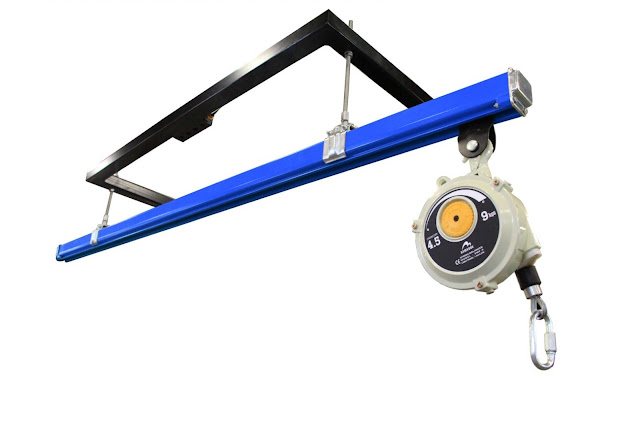
Flexible Mounting – Can be installed on ceilings, support beams, or overhead rails for optimal positioning.
Alignment with Workflows – Placement ensures tools do not obstruct operator movement or equipment.
Compatibility with Beam Trolleys – Facilitates horizontal mobility along the production line, combining vertical balance with horizontal travel.
Simple Adjustment – Fine-tuning spring tension during setup ensures precise and consistent tool balance.
Enhancing Assembly Line Performance
The operational efficiency of an assembly line is closely linked to tool stability and ease of use.
Consistent Tool Behavior – Maintains vertical stability for repetitive tasks, improving accuracy.
Reduced Manual Handling – Operators focus on the process instead of supporting heavy tools.
Improved Productivity – Balanced tools accelerate task execution while maintaining precision.
Equipment Protection – Smooth operation prevents mechanical shocks that can damage tools or balancer components.
-Maintenance and Long-Term Efficiency
Regular maintenance and strategic planning ensure spring balancers deliver consistent performance over time.
Routine Inspection – Regular checks of cables, hooks, and springs reduce unexpected downtime.
Lubrication and Cleaning – Keeps moving parts operational and free from debris.
Component Replacement – Springs, cables, or hooks can be serviced without full system removal.
Scalability and Adaptability – Balancers can be relocated or upgraded as production requirements evolve.
Conclusion
A detailed understanding of the spring balancer’s working principle is crucial for achieving consistent, safe, and ergonomic tool handling in industrial environments. By offsetting tool weight and integrating seamlessly with systems such as beam trolleys, spring balancers enhance assembly line efficiency, operator comfort, and overall productivity.
For organizations seeking reliable, precision-engineered solutions for tool management and industrial workflows, Powermaster America LLC provides spring balancers designed to deliver long-term operational benefits and safety.

.jpg)
Comments
Post a Comment