A Brief Understanding of Beam Trolley Systems for Smooth Moves in Industry

In the world of industrial lifting and material handling, precision, stability, and safety are key factors that define productivity. Among the many innovations designed to simplify the movement of heavy loads, beam trolley systems stand out for their efficiency and versatility. A beam trolley is a mechanical system that runs along a beam or track, allowing heavy objects to be moved horizontally with ease. Whether used in factories, warehouses, or construction sites, beam trolley systems make it possible to lift, position, and transport loads safely and accurately. They are often combined with hoists, forming a crucial part of material handling operations. Designed for both manual and powered operation, these systems offer flexibility across industries that rely on overhead lifting. Understanding how beam trolley systems work and their importance can help businesses improve workflow, reduce risks, and ensure smoother, more efficient handling of goods and materials.
What Exactly Is a Beam Trolley System
A beam trolley system is a simple yet powerful mechanical setup used to move heavy loads horizontally along a beam or girder. It usually consists of a wheeled carriage that rides along the lower flange of an I-beam. Attached to this carriage is a hoist, which lifts and lowers the load. Together, the hoist and trolley form a complete system capable of both vertical and horizontal movement. Depending on the need, beam trolleys can be manual, push-type, or motorized. Manual trolleys are ideal for smaller loads and precise control, while powered versions are used for larger, heavier operations. The design of the trolley allows it to glide smoothly along the beam, minimizing friction and effort while maintaining safety.
The Working Principle Behind Beam Trolleys
At its core, the beam trolley operates on a rolling mechanism that enables movement across a fixed track. The wheels of the trolley are mounted on bearings, ensuring smooth motion even under significant load. The hoist attached beneath the trolley does the vertical lifting, while the trolley itself moves the load horizontally along the beam. This dual-motion capability makes it ideal for repetitive lifting tasks in confined spaces. Operators can easily move the trolley by pushing, pulling, or controlling it through a motorized system, depending on the model. The combination of leverage, balance, and wheel-based motion makes beam trolleys efficient and reliable tools in any heavy-duty environment.
Key Applications Across Industries
Beam trolley systems are used in a wide range of industries where material handling is essential. In manufacturing plants, they are used to move components between workstations. In warehouses, they help transport goods from one section to another without the need for forklifts. Construction sites use beam trolleys to lift and shift building materials safely. Automotive workshops rely on them to handle heavy parts such as engines and machinery. Even in shipyards and power plants, beam trolleys play a crucial role in managing massive components with precision. Their ability to handle varying load capacities makes them a universal choice for both small-scale workshops and large industrial setups.
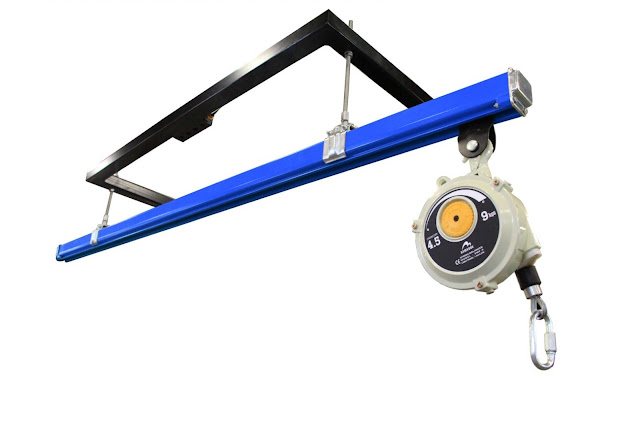
Beam trolley systems and spring balancer 5kg may appear simple, but their importance in modern industry is undeniable. As technology continues to evolve, beam trolley systems are also advancing, combining strength and intelligence to meet the growing demands of industrial efficiency. In essence, they represent the perfect balance between mechanical strength and smooth, controlled movement.

.jpg)
Comments
Post a Comment