How Do Manufacturers of Spring Balancers Guarantee Durability and Quality?

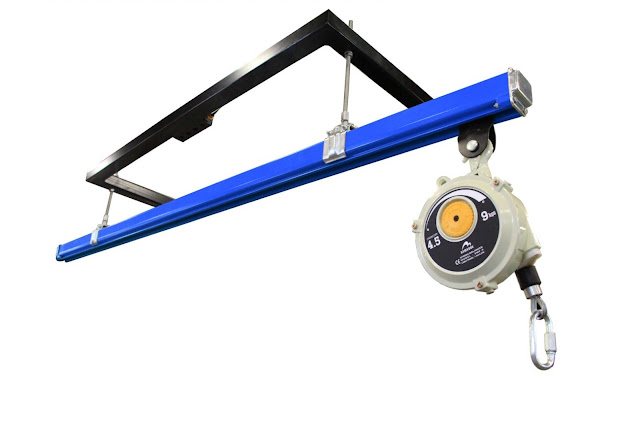
Spring balancers, also known as spring balancers in tools, are essential equipment used in most industrial purposes to assist and steady the weight of the tools during their operation. The quality and durability are the two factors that manufacturers should give high priority since they directly affect their longevity, performance, and safety. To create quality and durable spring balancers, the production process relies on the quality control, precision engineering, and the application of high quality materials. Let us describe how spring balancers manufacturers follow these rules throughout the whole production process.
Testing for Load and Fatigue to Ensure Durability
A crucial quality control procedure is load testing, which involves subjecting springs and constructed spring balancers to operational force simulations. The spring's conformance to the anticipated force-displacement relationship outlined by the spring balancer working principle is confirmed by applying controlled loads to assess the spring's deflection and retraction behavior. The device will measure and balance tool loads correctly in real-world applications if it is calibrated accurately during this testing phase.
Surface Cleaning and Corrosion Prevention Techniques
The surface treatment has a practical as well as aesthetic purpose. Wear and rust that could impair spring performance or cause mechanical issues are avoided by uniform coatings. Visual inspections both during and after coating applications guarantee the consistent coverage and surface integrity that are essential for preserving operational dependability.
Proper Assembling and Easy Functioning
Spring and bearing or pulley tension should be proper for the tool balancers' retractable features. These features enable an easy extension and smooth retraction of the cable supporting the tools. It also reduces the jerky motion with which the tool acts on the operator while maintaining measurement precision. Before shipping, the manufacturers test each device to ensure consistent cable travel and tension balance.
Certifications and Standard Compliance
Manufacturers match their manufacturing processes with industry certifications and worldwide quality management systems in order to maintain quality and safety standards. Throughout the manufacturing cycle, these frameworks guarantee traceability, constant improvement, and consistent product quality.
Compliance with safety standards about load capacity, user safety features, and mechanical integrity is another requirement for certification. Customers are reassured by conformance to these criteria that the spring balancer for tools fulfill strict quality standards and are dependable in demanding applications.
Continuous Product Testing and Integration of Feedback
Manufacturers implement continuous testing procedures for spring balancer batches even after production is complete. Stress testing and random sampling validate long-term dependability under various circumstances. The feedback provided by the end-user plays an imperative role in enhancing durability, fixing common wear problems, and adjusting designs.
Continuous innovation driven by this data can help manufacturers to enhance corrosion resistance, optimize the mechanical components to deliver higher load balancing performance, and enhance spring material compositions. This iterative method helps create spring balancers that are more durable, dependable, and easy to operate.
Conclusion
Manufacturers of spring balancers combine rigorous raw material selection, precise production, comprehensive load and fatigue testing, and strong surface protection measures to guarantee quality and endurance. Retractable tool balancers operate smoothly and dependably thanks to careful assembly.
This all-encompassing strategy, which is based on the basic spring balancer operating principle and reinforced by cutting-edge engineering techniques, produces robust devices that accurately balance loads and boost productivity in difficult industrial settings. The strict quality control ingrained in the production procedures guarantees that spring balancers constantly live up to the standards for dependability, security, and durability.

.jpg)
Comments
Post a Comment