The Role of Spring Balancers for Balancing Made Easy

In many industries, heavy tools and equipment are used repeatedly throughout the day. While these tools are essential for production and maintenance, their constant handling can cause worker fatigue, reduce efficiency, and even lead to injuries. This is where a spring balancer steps in as a game-changing device. A spring balancer supports the weight of a tool by suspending it from a cable connected to a spring mechanism. As the operator works, the spring maintains balance, making the tool feel almost weightless. This not only reduces strain on workers but also improves precision and workflow in the workplace.
What is a Spring Balancer?
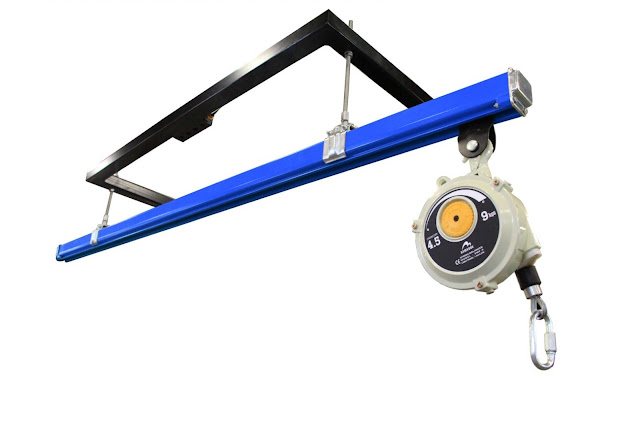
A spring balancer is a mechanical device designed to hold, balance, and control heavy tools during operation. It consists of a casing, a spring-loaded drum, and a retractable steel cable. The tool is attached to the cable, and the tension of the internal spring offsets the tool’s weight. This setup allows workers to move the tool freely without having to lift or carry its full weight. Spring balancers are commonly used in manufacturing units, assembly lines, welding shops, and automobile service stations.
How a Spring Balancer Works
The working principle is simple yet highly effective. Inside the balancer, a coil spring is pre-tensioned to counterbalance the load. When a tool is connected and pulled downward, the spring stretches, creating a lifting force equal to the tool’s weight. This force keeps the tool “floating” in the desired position, making it easy to move in any direction without much effort. Unlike hoists, a spring balancer does not lift tools vertically for storage—it’s meant to keep them readily accessible for continuous use.
Benefits of Using Spring Balancers
1. Reduced Worker Fatigue
By taking the tool’s weight off the operator’s hands, spring balancers minimize physical strain. This leads to less fatigue and more consistent productivity over long shifts.
2. Improved Safety
Heavy tools can cause accidents if dropped. With a spring balancer, the tool remains suspended and secured, reducing the risk of injuries or damage to equipment.
3. Enhanced Precision
Since operators are not burdened by the tool’s weight, they can focus more on accuracy, which is crucial in detailed assembly or welding work.
4. Longer Tool Life
Suspending tools when not in direct use prevents them from hitting the ground or being mishandled, thereby increasing their lifespan.
Types of Spring Balancers
1. Light-Duty Balancers – Used for small tools weighing less than 2 kg, ideal for electronics or light assembly work.
2. Medium-Duty Balancers – Designed for tools weighing between 2 kg and 10 kg, commonly used in automotive workshops.
3. Heavy-Duty Balancers – Built for industrial applications, capable of balancing tools or equipment up to 100 kg or more.
Applications in Various Industries
Spring balancers are widely used in industries where tools are frequently handled. In automobile manufacturing, they help mechanics manage heavy impact wrenches. In shipbuilding, they assist welders with large welding torches. In electronics assembly, they keep lightweight screwdrivers suspended for quick and easy use. Their versatility makes them valuable in almost every production environment.
A balancer spring may seem like a simple device, but its impact on productivity, safety, and worker comfort is significant. By reducing effort and improving handling precision, it becomes an indispensable tool in various industries. Investing in the right spring balancer not only protects workers but also enhances operational efficiency—a balance every workplace needs.

.jpg)
Comments
Post a Comment